Posts

The Best Viking Novels

Image
I don't know about you, but I love a good viking novel. I've been interested in history since I was a kid, and I've always been fascinated by the vikings. There's something about the stories of dragon ships and adventures on the sea that capture the imagination.  And, I'm certainly not the only person who thinks that way because there are a lot of books about vikings on the market. Of course, there are plenty of non-fiction books out there, and I've read (or listened to; I love audiobooks) to a couple of them, but novels about vikings seem to be much more popular. That being said, not all novels are equal. Personally, I prefer viking novels that encompass the perfect amount of adventure, drama, and (sometimes) romance.  Since I've been home a lot recently, I've been reading/listening (I love audiobooks) to some old favorites and to some new novels as well. So, today, I want to share some of my favorite viking novels (in no particular order) with you. Ha...

Howl's Moving Castle & Destiny

Image
Once again, I'm super behind on the popular books band wagon. For example, I just read Outlander by Diana Gabaldon two months ago (which, I remember, was super popular approximately six years ago). In that vein, I just finished reading Howl's Moving Castle by Diana Wynne Jones. Yes, I'm aware that it became super popular circa 2004 and that the movie version is a cult classic. So, on average, it takes nine years for me to get around to reading a popular book. Anyway, I read  Howl's Moving Castle  and I absolutely loved it. I found it to be a charming and very sweet novel. In contrast to typical high fantasy novels, I found it to be a straight forward, enjoyable story. The book begins with  "In the land of Ingary, where such things as seven-league boots and cloaks of invisibility really exist, it is quite a misfortune to be born the eldest of three."   I was drawn into the novel immediately; the story was intriguing and funny and a joy to read. Jones mast...

Noa Noa: Paul Gauguin & Romanticism

Image
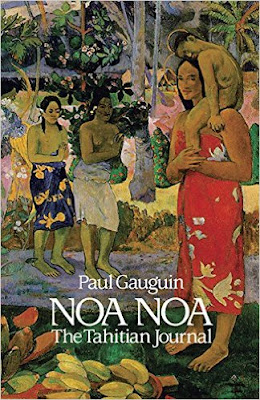
Paul Gauguin is one of my favorite painters. (Actually, as I write this, there is a print of his painting  Mahana No Atua hanging next to me on my bedroom wall.) So, during my winter break, I decided to read his Tahitian journal, Noa Noa . Noa Noa is a travelogue written by Gauguin, first published in 1901. Although, Gauguin billed the book as his genuine experiences, it seems pretty clear to me and other critics that it's mostly fictional or exaggerated. That being said, I found the book to be very interesting. From a narrative perspective, Noa Noa is a bit dull. Gauguin's writing style has a tendency to be wordy and pedantic. However, from an ideological perspective it's quite interesting. To my mind, Gauguin is an excellent example of Romanticism and Romantic thought. If you don't know, Romanticism was an artistic and ideological movement that reacted against the Enlightenment. Romantics believed that the world could not be understood purely though the le...

The Sleeper and the Spindle & the Uncanny

Image
So, I think Neil Gaiman is a genius -- and also a deeply disturbed individual -- and here's why. I just finished reading one of Neil Gaiman's newest books The Sleeper and the Spindle . I make it my business to pay attention to everything Neil Gaiman writes, however, if you haven't heard of this book, suffice it to say that it is a really, really twisted version of the Sleeping Beauty story. The premise of the story is that, about seventy years ago, a princess was cursed by a witch, causing her to sleep forever. The sleeping curse, which had previously been contained to the princess' castle, suddenly begins to spread throughout the world, causing many thousands of people to fall asleep and not to wake. A young queen -- who remains nameless -- sets out to wake the princess and lift the curse. I won't go into the details because I don't want to spoil the story, however, the conclusion of the story is basically the opposite of the Sleeping Beauty story in every wa...

Shakespeare & the World in Conflict

Image
A little while ago, I saw a documentary about Shakespeare's mother , which talked about all of the social and political changes that occurred in the lifetime of Shakespeare and his mother. Although I know quite a bit about the history of England, it never really occurred to me that Shakespeare lived through the dynastic shift between the Tudors and the Stuarts and was born shortly after Elizabeth I established Protestantism as the official religion of England. Although England's official religion would remain constant for the rest of Shakespeare's life, in the lifetime of his mother England's religion changed three times. These important shifts would certainly form an important backdrop in Shakespeare's life, particularly in a world in which religion determined how everyone saw the world and their place in it. In fact, there is some speculation that Shakespeare and his family remained Catholic even after the Protestant Reformation, further muddying the waters. Wha...

Book Review: A Knight of the Seven Kingdoms

Image
As some of you know, I'm a big fan of the Game of Thrones series (AKA The A Song of Ice and Fire Series ), and, like many fans, I've been waiting a long time for the sixth book in the series -- The  Winds of Winter -- to come out. The last book in the series was published in 2011, so, as you can imagine, fans are getting a little antsy. However, all you Game of Thrones fans out there can get your Westeros fix with  A Knight of the Seven Kingdoms , which was released earlier this year. George R.R. Martin's latest novel is a compilation of the Tales of Dunk and Egg, a set of three novellas that were written between 1998 and 2010. As a bit of background, Knight takes place about one hundred years before the events in  A Game of Thrones  and follows the story of Dunk, "Ser Duncan the Tall," and Egg, Aegon Targaryen. Most fans consider it to be a sort of prequel, for lack of a better word -- although, it's really just a story set in the same universe. Howeve...

Fascinating Characters: Kate, Henry IV Part I

Image
Not gonna lie, I'm not a big fan of Henry IV. Everyone's always trying to tell me "but blah blah blah Falstaff", "but blah blah blah power politics" and I'm like "eh, cool story bro". But one scene from this play has always fascinated me: Act II, Scene III. This scene is unique in the play, not only is it the only scene to include a woman (at least a woman who actually has lines) but because it gives us a unique glimpse into domestic life and issues of gender. That one speaking female character is Lady Percy, also known as Kate (although her real life counterpart's name was Elizabeth). Kate is a woman in a man's world. As her husband, Henry Percy, Hotspur, famously says: ...this is no world / To play with mammets [dolls] and to tilt with lips: / We must have bloody noses and crack'd crowns... -William Shakespeare But what is interesting about Kate is the way she attempts to resist this world centered on patriarchy. She is...

Katherine is a Classic

Image
So, I recently discovered the novel Katherine by Anya Seton. I don't know what it is, but there's something about historical fiction that was written in the 1950s that's just irresistible. I simply devoured this novel. Seton writes with true mastery and style (rare in modern historical fiction); she has a flair for description, and incorporates fact and fiction seamlessly while adding a deft touch of humor and magic. In case you don't know, Katherine is the best known work of author Anya Seton, a true master work in many respects, and considered a classic by many. The novel follows the story of Katherine Swynford, the mistress of the famous John of Gaunt, Duke of Lancaster. Considered one of the greatest true medieval love stories, Katherine was Gaunt's mistress for nearly decades before he married her in what can only be described as a fairy tale ending. This fascinating book tells Katherine's story through war, revolt, heart break, and reconciliation. ...

Jamaica Inn: Some Thoughts on the Gothic

Image
I came to this wonderful book in a convoluted way. A few months ago, I set a google alert for Downton Abbey , because, let's be honest, who doesn't want to see who Mary Crowley marries? Anyway, the alert turned up a lot of interesting articles about the show, but it also turned up a few articles about Jessica Brown Findlay. Findlay played Sibyl Crowley on the show, but she left in season three to explore other acting opportunities. I'm so glad she did. A little while ago, I read an article about Jessica Brown Findlay's new role in BBC One's TV series,  Jamaica Inn . I was like, 'hm, that sounds interesting', and proceeded to look up the show on Wikipedia, whereupon I learned that Jamaica Inn was actually based on a book of the same title. I have since read that book and let me just say: It was amazing. Maybe it's just that I haven't read a book for pleasure in a while, but I can honestly say that Jamaica Inn was one of the best written, ...

Fragile Things is Frickin' Good

Image
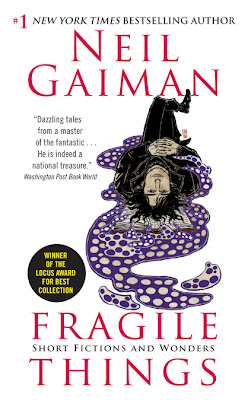
So, I'm not usually a big fan of short stories, but recently I've been reading Neil Gaiman's Fragile Things , a collection of short fiction. Now, I think I've said this before, but I'll say it again: everything Neil Gaiman writes is genius ! And Fragile Things is no exception. It's one of the strangest books I've ever read, but I loved every minute of it. It was just so wonderfully weird. I mean, the only way I can really even explain this book is that it was like taking a walk  through someone else's dreams. It was that surreal. Actually, given the cover art, I think that that is actually quite a good analogy. Whoever designed the cover of this book had a really good idea of what it was about and what it was trying to accomplish. I love how it looks like the contents of his brain is draining out onto the book. It's such a powerful image. Really good writing, I think, should be a walk through the writer's mind, and I think Neil Gaiman accompl...

Andromache vs. Hermione: Some Thoughts on Euripides

Image
So, recently I read the play Andromache by Euripides, because you know, I like Greek tragedy because it's just so cheerful. Anyway, this time I made the unusual move of reading the introduction reading a paragraph and a half of the 10 million page introduction and something it said caught my attention. The introduction was talking about how the play was written on the premise of a the best of women in the worst of circumstances. While that seemed like a valid idea at the time, after I actually read the play, I thought that that was a really weird thing to say. In case you're not familiar with Andromache , I'll give you a super quick summary. It's the story of Hector's (Hector is the prince of Troy) wife after the fall of Troy. Andromache has been taken prisoner by the Greeks and given to the son of Achilles (Neoptolemos) to be his wife/slave. After a few years, and, importantly, after Andromache has had a son to Neoptolemos, Neoptolemos marries Hermione, the ...

I Do Not Have a Gentle Heart: Some Thoughts on Women in A Song of Ice and Fire

Image
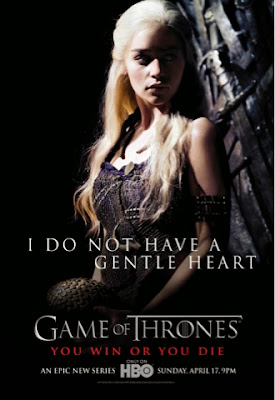
In case you don't read my main blog , let me tell you that I'm a huge fan of the A Song of Ice and Fire series and the Game of Thrones TV series. One of the reasons I like it so much, is that the characters are so realistic and well rounded, especially the female characters. So often in fantasy novels that take place in a medieval world, the female characters take one of three forms: the tough but noble  do-gooder, the evil queen, and the locked in a tower princess. I think this is partly because  medieval writers had an extremely limited vocabulary when describing women, so fantasy writers who look back to that time period think that only two types of women existed in the medieval age: the paragon of virtue and the disgrace to the human race. What's so often ignored is that no one individual embodies any one of these archetypes. Real people aren't just evil queens or damsels in distress; they're a mixture of both. And no character exemplifies that princip...

Favorite Books: The Eagle of the Ninth

Image
I was first introduced to The Eagle of the Ninth by Rosemary Sutcliff by the movie version of the book, The Eagle . The Eagle was a great movie, mostly because it involved face paint and Channing Tatum. So, after I saw it, I decided to read the book, and, after I read the book, I hated the movie, because the book was so much better. The Eagle of the Ninth tells the story of a Roman centurion, Marcus, stationed in Roman Britain. Marcus comes from a long line of soldiers. His father marched with the Ninth Legion, which disappeared in the old Roman province of Valentia. Marcus is haunted by the memory of his father's legion and longs to lift this shame from his family's name. After Marcus is injured in battle and forced to leave the army, he decides to journey north of Hadrian's wall to try to recover the lost Eagle of his father's legion. What follows is a stunning adventure that spans the length of Britain. The story is that the author actually based the book o...

Books you Should Read Before you Die

So, the other day I was on Facebook, you know, like your typical college student with three billion pages to read a night, and I found one of those list challenge where you go through a list of things and mark all the things on the list you've done. Anyway, I found one that was called '50 Books to Read Before You Die'. Anyway, I read a lot, so I thought it I would try it, but out of 50, I'd only read 19, and, while most of the books on the list are famous and well known and note-worthy, I don't think my life would be significantly different if I hadn't read Frankenstein. Which, by the way, was like the dullest book I've ever read. I don't really like this whole idea of list of "necessary" books. It's hard to create a list of books that everyone should read before they die because, obviously, not everyone likes the same sort of thing. That's not to say that I don't think dark or boring books can be valuable. For examp...

The Problem of Helen: The Trojan Women

Image
So, I just finished reading The Trojan Women by Euripides (I don't know if you can tell, but I'm a bit of a Euripides fan) and it raised an interesting question for me: can we blame Helen for the fall of Troy? If you don't know, The Trojan Women explores the aftermath of the sack of Troy, particularly what happens to the women of Troy, who have been taken as slaves by the Greek soldiers. Both the Trojans and the Greeks feel that Helen is responsible for the war (for good reason), but Helen herself argues that she is innocent. Helen tells Menelaus that Aphrodite made her run off with Paris and that after Paris was dead she tried to go back to Menelaus. That sounds like a pretty lame excuse to me, but it doesn't seem fair that the entire war should be blamed on Helen either. Depending on the source, I've come across two different versions of the Helen of Troy story, one that says she was kidnapped and one that says she went willingly. Personally, I can't ima...

Favorite Books: The Voyage of the Dawn Treader

Image
I realized today that it's been a while since I wrote one of these favorite book blogs. So, today I want to tell you about The Voyage of the Dawn Treader . The Voyage of the Dawn Treader is one of the books in The Chronicles of Narnia series, technically, it's the third book in the series (in publication order), but it makes the most sense to read it as the fourth book. It frustrates me that, when people think of The Chronicles of Narnia , they automatically think of The Lion, The Witch, and the Wardrobe . Not to say that it's not a great book, but the Narnia books are so much more interesting, so much more complex that. The Voyage of the Dawn Treader is so monumental in scope . They made a movie version of it, but it didn't really capture what the book was all about. They tried to make it an adventure story, which it is, but it's so much more than that. In The Voyage of the Dawn Treader we see so much more of Narnia than ever before. It really begins to tak...

The Sound and the Fury: Macbeth

Image
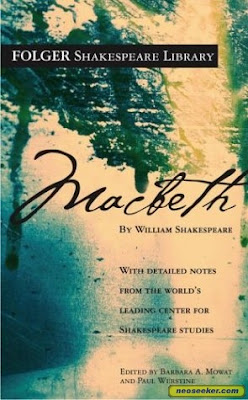
So, I think everyone in the world can agree that The Scottish Play is top-shelf bard. To my understanding, it is the play against which all other tragedies and histories (you could make the argument that Macbeth is a history, don't fight me on this) are measured (except for Richard III , nothing beats Richard III ). There are a lot of reasons why The Scottish Play is the classic that it is, a lot of reasons that scholars love to analyze it. But my favorite thing about Macbeth is that it's so, so, very weird (as in strange, not as in the Weird Sisters - hang on, we're getting there). Seriously; it's bizarre! I know that in a world that contains alligator hot dogs, the vampire birth scene in Breaking Dawn , and the English system, everything else seems fairly normal, but, it you consider it, Macbeth is a really strange play. There are apparitions, witches, and ghosts; at various times in the play, horses eat each other and chimneys are blown down by the force of one...