Posts

Jamaica Inn: Some Thoughts on the Gothic

Image
I came to this wonderful book in a convoluted way. A few months ago, I set a google alert for Downton Abbey , because, let's be honest, who doesn't want to see who Mary Crowley marries? Anyway, the alert turned up a lot of interesting articles about the show, but it also turned up a few articles about Jessica Brown Findlay. Findlay played Sibyl Crowley on the show, but she left in season three to explore other acting opportunities. I'm so glad she did. A little while ago, I read an article about Jessica Brown Findlay's new role in BBC One's TV series,  Jamaica Inn . I was like, 'hm, that sounds interesting', and proceeded to look up the show on Wikipedia, whereupon I learned that Jamaica Inn was actually based on a book of the same title. I have since read that book and let me just say: It was amazing. Maybe it's just that I haven't read a book for pleasure in a while, but I can honestly say that Jamaica Inn was one of the best written, ...
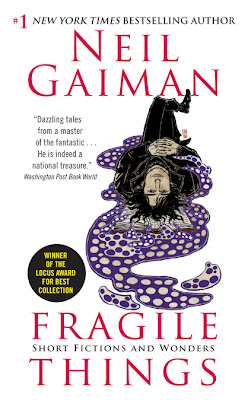
Fragile Things is Frickin' Good

Image
So, I'm not usually a big fan of short stories, but recently I've been reading Neil Gaiman's Fragile Things , a collection of short fiction. Now, I think I've said this before, but I'll say it again: everything Neil Gaiman writes is genius ! And Fragile Things is no exception. It's one of the strangest books I've ever read, but I loved every minute of it. It was just so wonderfully weird. I mean, the only way I can really even explain this book is that it was like taking a walk  through someone else's dreams. It was that surreal. Actually, given the cover art, I think that that is actually quite a good analogy. Whoever designed the cover of this book had a really good idea of what it was about and what it was trying to accomplish. I love how it looks like the contents of his brain is draining out onto the book. It's such a powerful image. Really good writing, I think, should be a walk through the writer's mind, and I think Neil Gaiman accompl...

Andromache vs. Hermione: Some Thoughts on Euripides

Image
So, recently I read the play Andromache by Euripides, because you know, I like Greek tragedy because it's just so cheerful. Anyway, this time I made the unusual move of reading the introduction reading a paragraph and a half of the 10 million page introduction and something it said caught my attention. The introduction was talking about how the play was written on the premise of a the best of women in the worst of circumstances. While that seemed like a valid idea at the time, after I actually read the play, I thought that that was a really weird thing to say. In case you're not familiar with Andromache , I'll give you a super quick summary. It's the story of Hector's (Hector is the prince of Troy) wife after the fall of Troy. Andromache has been taken prisoner by the Greeks and given to the son of Achilles (Neoptolemos) to be his wife/slave. After a few years, and, importantly, after Andromache has had a son to Neoptolemos, Neoptolemos marries Hermione, the ...

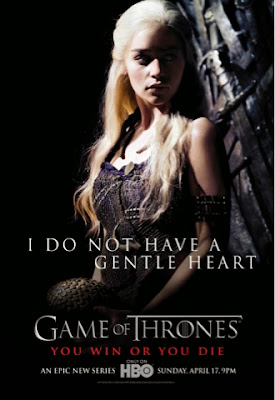
I Do Not Have a Gentle Heart: Some Thoughts on Women in A Song of Ice and Fire

Image
In case you don't read my main blog , let me tell you that I'm a huge fan of the A Song of Ice and Fire series and the Game of Thrones TV series. One of the reasons I like it so much, is that the characters are so realistic and well rounded, especially the female characters. So often in fantasy novels that take place in a medieval world, the female characters take one of three forms: the tough but noble  do-gooder, the evil queen, and the locked in a tower princess. I think this is partly because  medieval writers had an extremely limited vocabulary when describing women, so fantasy writers who look back to that time period think that only two types of women existed in the medieval age: the paragon of virtue and the disgrace to the human race. What's so often ignored is that no one individual embodies any one of these archetypes. Real people aren't just evil queens or damsels in distress; they're a mixture of both. And no character exemplifies that princip...

Favorite Books: The Eagle of the Ninth

Image
I was first introduced to The Eagle of the Ninth by Rosemary Sutcliff by the movie version of the book, The Eagle . The Eagle was a great movie, mostly because it involved face paint and Channing Tatum. So, after I saw it, I decided to read the book, and, after I read the book, I hated the movie, because the book was so much better. The Eagle of the Ninth tells the story of a Roman centurion, Marcus, stationed in Roman Britain. Marcus comes from a long line of soldiers. His father marched with the Ninth Legion, which disappeared in the old Roman province of Valentia. Marcus is haunted by the memory of his father's legion and longs to lift this shame from his family's name. After Marcus is injured in battle and forced to leave the army, he decides to journey north of Hadrian's wall to try to recover the lost Eagle of his father's legion. What follows is a stunning adventure that spans the length of Britain. The story is that the author actually based the book o...

Books you Should Read Before you Die

So, the other day I was on Facebook, you know, like your typical college student with three billion pages to read a night, and I found one of those list challenge where you go through a list of things and mark all the things on the list you've done. Anyway, I found one that was called '50 Books to Read Before You Die'. Anyway, I read a lot, so I thought it I would try it, but out of 50, I'd only read 19, and, while most of the books on the list are famous and well known and note-worthy, I don't think my life would be significantly different if I hadn't read Frankenstein. Which, by the way, was like the dullest book I've ever read. I don't really like this whole idea of list of "necessary" books. It's hard to create a list of books that everyone should read before they die because, obviously, not everyone likes the same sort of thing. That's not to say that I don't think dark or boring books can be valuable. For examp...

The Problem of Helen: The Trojan Women

Image
So, I just finished reading The Trojan Women by Euripides (I don't know if you can tell, but I'm a bit of a Euripides fan) and it raised an interesting question for me: can we blame Helen for the fall of Troy? If you don't know, The Trojan Women explores the aftermath of the sack of Troy, particularly what happens to the women of Troy, who have been taken as slaves by the Greek soldiers. Both the Trojans and the Greeks feel that Helen is responsible for the war (for good reason), but Helen herself argues that she is innocent. Helen tells Menelaus that Aphrodite made her run off with Paris and that after Paris was dead she tried to go back to Menelaus. That sounds like a pretty lame excuse to me, but it doesn't seem fair that the entire war should be blamed on Helen either. Depending on the source, I've come across two different versions of the Helen of Troy story, one that says she was kidnapped and one that says she went willingly. Personally, I can't ima...