Posts

Showing posts with the label Plays

Shakespeare & the World in Conflict

Image
A little while ago, I saw a documentary about Shakespeare's mother , which talked about all of the social and political changes that occurred in the lifetime of Shakespeare and his mother. Although I know quite a bit about the history of England, it never really occurred to me that Shakespeare lived through the dynastic shift between the Tudors and the Stuarts and was born shortly after Elizabeth I established Protestantism as the official religion of England. Although England's official religion would remain constant for the rest of Shakespeare's life, in the lifetime of his mother England's religion changed three times. These important shifts would certainly form an important backdrop in Shakespeare's life, particularly in a world in which religion determined how everyone saw the world and their place in it. In fact, there is some speculation that Shakespeare and his family remained Catholic even after the Protestant Reformation, further muddying the waters. Wha...

Fascinating Characters: Kate, Henry IV Part I

Image
Not gonna lie, I'm not a big fan of Henry IV. Everyone's always trying to tell me "but blah blah blah Falstaff", "but blah blah blah power politics" and I'm like "eh, cool story bro". But one scene from this play has always fascinated me: Act II, Scene III. This scene is unique in the play, not only is it the only scene to include a woman (at least a woman who actually has lines) but because it gives us a unique glimpse into domestic life and issues of gender. That one speaking female character is Lady Percy, also known as Kate (although her real life counterpart's name was Elizabeth). Kate is a woman in a man's world. As her husband, Henry Percy, Hotspur, famously says: ...this is no world / To play with mammets [dolls] and to tilt with lips: / We must have bloody noses and crack'd crowns... -William Shakespeare But what is interesting about Kate is the way she attempts to resist this world centered on patriarchy. She is...

Andromache vs. Hermione: Some Thoughts on Euripides

Image
So, recently I read the play Andromache by Euripides, because you know, I like Greek tragedy because it's just so cheerful. Anyway, this time I made the unusual move of reading the introduction reading a paragraph and a half of the 10 million page introduction and something it said caught my attention. The introduction was talking about how the play was written on the premise of a the best of women in the worst of circumstances. While that seemed like a valid idea at the time, after I actually read the play, I thought that that was a really weird thing to say. In case you're not familiar with Andromache , I'll give you a super quick summary. It's the story of Hector's (Hector is the prince of Troy) wife after the fall of Troy. Andromache has been taken prisoner by the Greeks and given to the son of Achilles (Neoptolemos) to be his wife/slave. After a few years, and, importantly, after Andromache has had a son to Neoptolemos, Neoptolemos marries Hermione, the ...

The Problem of Helen: The Trojan Women

Image
So, I just finished reading The Trojan Women by Euripides (I don't know if you can tell, but I'm a bit of a Euripides fan) and it raised an interesting question for me: can we blame Helen for the fall of Troy? If you don't know, The Trojan Women explores the aftermath of the sack of Troy, particularly what happens to the women of Troy, who have been taken as slaves by the Greek soldiers. Both the Trojans and the Greeks feel that Helen is responsible for the war (for good reason), but Helen herself argues that she is innocent. Helen tells Menelaus that Aphrodite made her run off with Paris and that after Paris was dead she tried to go back to Menelaus. That sounds like a pretty lame excuse to me, but it doesn't seem fair that the entire war should be blamed on Helen either. Depending on the source, I've come across two different versions of the Helen of Troy story, one that says she was kidnapped and one that says she went willingly. Personally, I can't ima...

The Sound and the Fury: Macbeth

Image
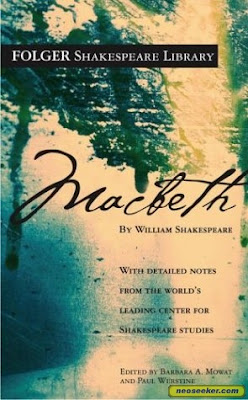
So, I think everyone in the world can agree that The Scottish Play is top-shelf bard. To my understanding, it is the play against which all other tragedies and histories (you could make the argument that Macbeth is a history, don't fight me on this) are measured (except for Richard III , nothing beats Richard III ). There are a lot of reasons why The Scottish Play is the classic that it is, a lot of reasons that scholars love to analyze it. But my favorite thing about Macbeth is that it's so, so, very weird (as in strange, not as in the Weird Sisters - hang on, we're getting there). Seriously; it's bizarre! I know that in a world that contains alligator hot dogs, the vampire birth scene in Breaking Dawn , and the English system, everything else seems fairly normal, but, it you consider it, Macbeth is a really strange play. There are apparitions, witches, and ghosts; at various times in the play, horses eat each other and chimneys are blown down by the force of one...

Medea as a Work of Protofeminism

Image
So, if you're ever upset because you've done something that you regret, then you should read Euripides' Medea , because nothing you could ever do could be as bad as what happens in Medea . As you know, I've been reading a lot of Greek tragedy, but their is nothing more Greek or more tragic than this play. Medea is the story of Medea, the wife of Jason (as in Jason and the Argonauts). The backstory is a little complicated, but basically what happens is that Medea betrays her family to help Jason and, in exchange, he marries her and they have two sons. They go to Corinth, where Jason precedes to abandon Medea in order to marry the daughter of the king. Medea's very logical response to this is to kill her children and Jason's new wife. Obviously, there's some nuance I'm skipping over, but that's pretty much the gist of it. Like, seriously, Edgar Allan Poe couldn't make this stuff up. Aside from all the gore, however, this is an interesting ...

Electra, Electra

Image
So, a little while ago, for fun, I read the Oresteia of Aeschylus. In general, I'm a big fan of Greek tragedy, but the Oresteia was really something else. The great thing about Greek tragedy is that you get this huge outpouring of emotion in a very short, condensed space. It took me about two hours to read the Oresteia, but when I was done I felt like someone had just punched me in the stomach. There's something so vital about Greek tragedy; it has a huge emotional impact. I mean, you just don't get that from other works of poetry or fiction. Anyway, one of the reasons I liked the Oresteia is because you're never really sure whose side your on.  Obviously, Clytemnestra did a horrible thing by killing her husband, but her husband should not have killed her daughter. By the same token, two wrongs don't make a right; Orestes should not have killed his mother, Clytemnestra. Like, is this one messed up family or what? While most everyone sides with Orestes and Ele...

Shakespeare's Histories: The Dramatization of Actual People

Image
As an English major, I have to have an opinion about Shakespeare. Personally, I'm a fan of the histories. I like the comedies as much as the next person, but I think that there's some perspective to be gained from reading dramatizations of real (or mostly real) events. I quite like King John and Macbeth (which, in my opinion is both a tragedy and a history), but my favorite Shakespeare play is, without a doubt, Richard III . While half the fun of Richard III is Richards wile and villainy, I think that a lot of people make a mistake when they assume that Shakespeare's Richard is the same as the historical Richard. I recently wrote a post on my main blog about my evolving opinion of Richard III ; to make a long story short, I think that, while Richard made some bad decisions, he wasn't evil. It was hard to be a good guy in England during the War of the Roses. Even the much applauded Edward IV was capable of extreme acts of brutality and even executed his own brot...

Jones, Lysistrata Jones

Image
So, yesterday I read Lysistrata (I can say that because I've recently discovered that if you cut out video streaming on the internet (aka YouTube), you can read a lot more), and I have to say that I really enjoyed it. Not only was it a quick read, but the version I read had illustrations by Picasso, which was a real treat. Considering that, previous to this, my only exposure to ancient Greek drama was when I read Oedipus Rex , Oedipus at Colonus , and Antigone in 9th grade English. Now, I understand that most people would probably consider Lysistrata slightly inappropriate for high school, given that it's essentially about a sex strike. However, I have to say, I think The Three Theban plays are far more disturbing. I mean, if it's okay to read a play centered around incest, I think it's okay to read a play about a bunch of women who decide to go abstinent. I think that's a better message for high school kids. Besides, the play is defined as a comedy, so I t...